
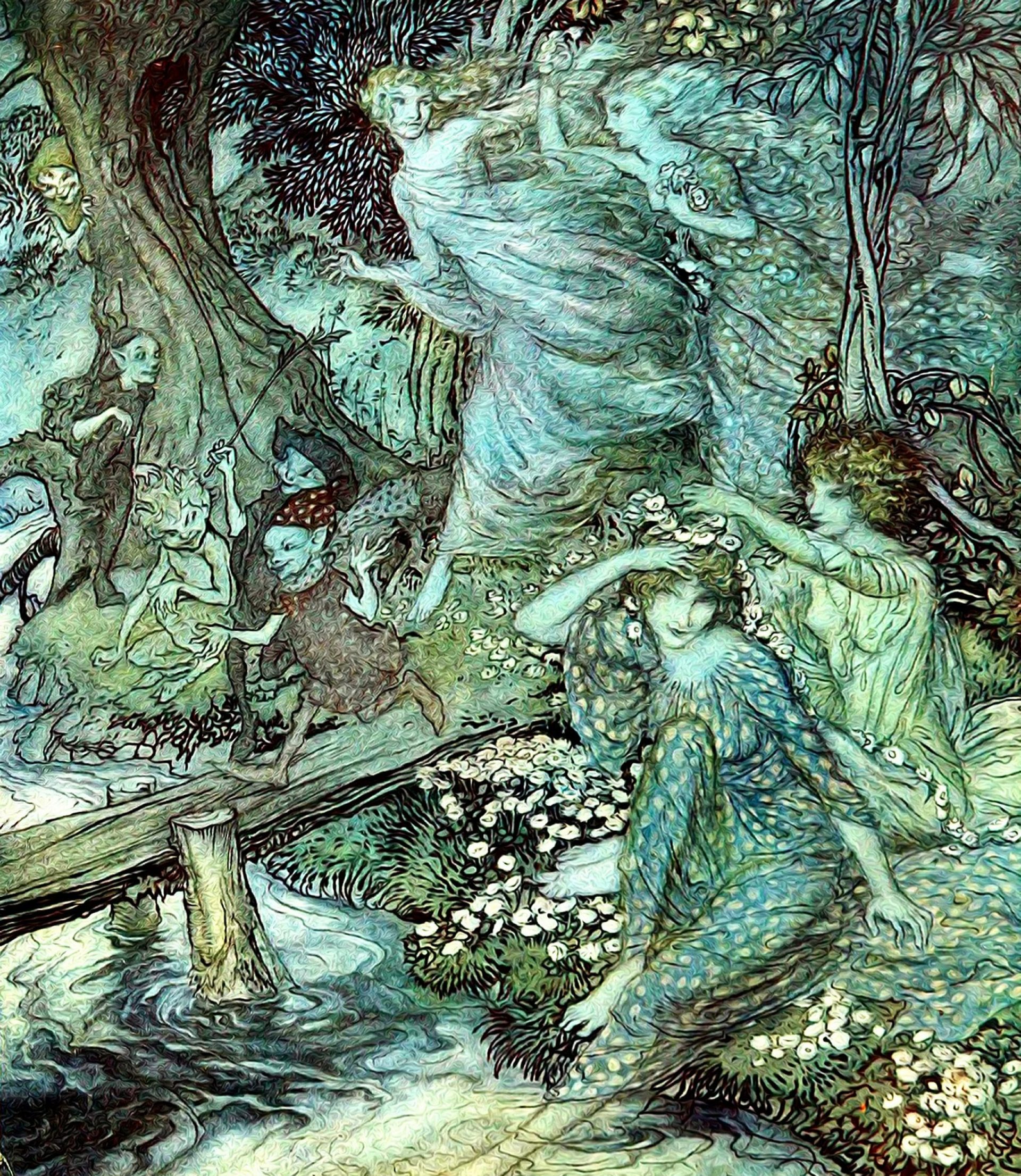
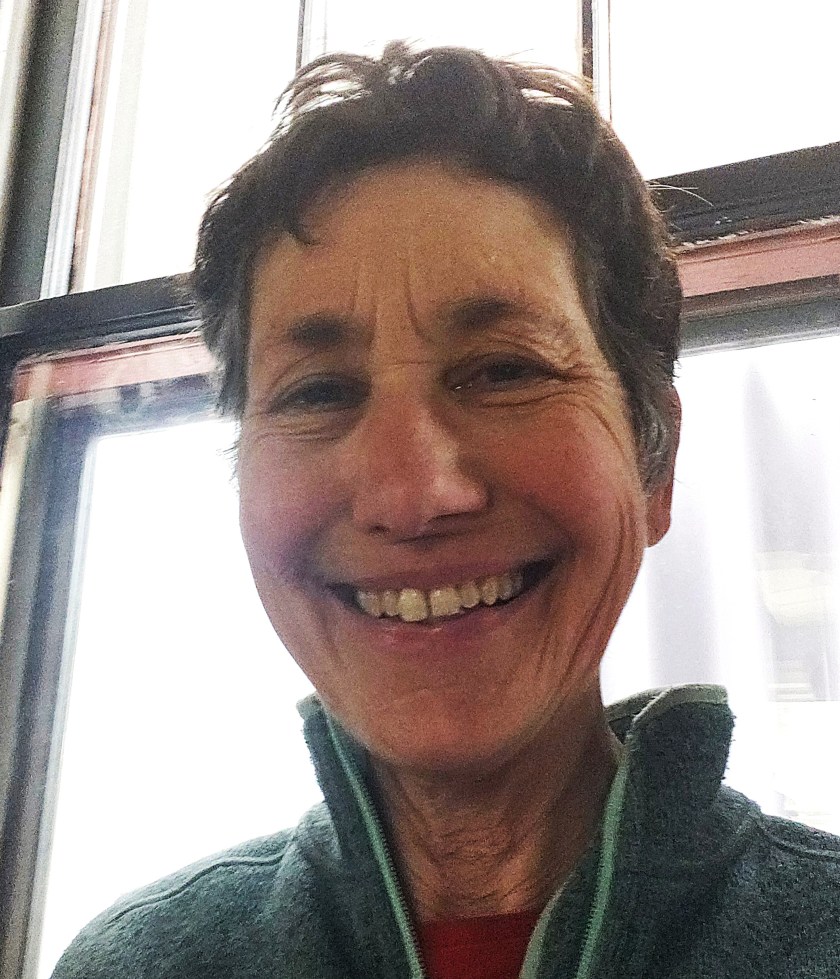
For this special spring edition of our Author’s Spotlight feature, we would like to share an author who has stretched her creativity across multiple modes of storytelling, from the page to the canvas to the puppet theater. Below is the story that got our attention: “What You Wish For,” a color punch of worldbuilding within the small space of a flash fiction, with a sting at the tail end.
As we usually do with our Author’s Spotlight feature, we also asked Joann Kielar to share her thoughts and her experiences on carving out a space for herself in the literary sphere. Her responses include reflections on what drives her to write and how her voice as an artist and writer has developed across the years. You can read our interview with Joann at the bottom of the page, or jump to it here.
“What You Wish For”
by Joann Kielar
Vernon and I were sitting on one of the stone benches near the empty fountain in the town square, where we liked to meet and talk. The marble putti still posed on the edges of the fountain’s upper bowls in cherubic clusters. Their plump cheeks were still stubbornly dented by petrified dimples, but that day their smiling mouths looked thirsty. I tossed a penny and heard it clink on the dry curve of the lowest bowl. My wish was for rain.
Vern pointed to the approaching woman, noticing her when she was still far off, heading south toward our town on that narrow road that seems to come from nowhere. We watched her closely, noticing details as she got nearer. When she was close enough, we saw that her feet were bare and dusty as if they had carried bits of faraway dry places with them. She wore a gauzy dress that settled on the peaks and valleys of her slender, tanned frame like the snow that once settled on mountaintops.
There was a big dark cloud, right above the woman. Maybe it was an illusion, but as she got closer, the cloud seemed to grow and, when she got close enough, we saw that she was towing the cloud behind her like a balloon on a string. As she passed directly in front of us, Vernon stood and joined her on the road, just below the cloud, as if he would follow her to the ends of the earth, as if her heat and dryness meant everything to him. Vernon was older than I and had a clearer memory of the time before the drought.
But then the woman turned from the road and walked toward the dry riverbed just beyond the town square. Vern stood his ground, looking in her direction for a moment to watch as she reached the river’s border of faded boats, their paint cracking and peeling in the sun. He hesitated for just a second but kept to the road and continued to walk due south. I watched him grow smaller and smaller until he was nothing more than a speck of grit on the horizon following some instinct, through the familiarity of searing heat. I believe Vern felt change in the air. In his long life he had taught himself to be wary of change.
By the time she reached the center of the riverbed, word of the woman’s arrival had spread like the bristle of swarming locusts and townspeople appeared everywhere. Men came to the doorways of their empty shops, rubbing red-rimmed eyes. Women, the ends of their hair brittle and split, wiped circles with the tails of their blouses in the grimy glass of second-floor windows and held up their children to watch the visitor. The pallid fabric of her dress moved in the hot wind as she anchored herself in the middle of the riverbed, her feet placed broadly. She raised her brown arms, boney tree branches begging the sky for sustenance, and the great gray cloud above her split open.
How the rain fell, pelting the ground like fistfuls of grapes, unceasing. Great wet orbs hit everything and everyone, as all the townspeople ran into the streets. We celebrated the rain with such abandon that we hardly noticed when the visitor was carried away by the waters of the now-burgeoning river.
At first, we would call her martyr and savior. But later, when the town was always moist, when it rained for most of every day, when the once-dusty households and shops were encrusted with mildew, she was thought of only as the-one-who-changed-everything. Then Vernon was called seer and prophet, the one who knew the value of balance. “Be careful what you wish for…” the townsfolk would say, raising one wet finger in warning.
Now I often sit alone in the gray square staring at the muddy road out of town. I want to believe that Vern will return, bringing with him a hot, dry wind. I want to spot him in the distance on the road dragging thick chunks of parched sod behind him on ropes, into town, absorbing the wetness that is everywhere.
I blot the rain from my face and wipe the spots from my glasses and remember the smell of dust and the pleasure of the tiniest sliver of ice melting on a dehydrated tongue. From the bench near the fountain, I look toward my neighbors shivering aboard their rotting boats, bobbing in the bloated river near its overgrown banks, and I search for contented faces. The only contentment I find now is on the faces of the putti playing in the cascading waters of the overflowing fountain, water that sometimes splashes the umbrella of a townsperson passing hurriedly through the town square in search of a place to keep dry.
Interview with Joann Kielar
In your background, you mention being a visual artist and a puppeteer, as well as a writer and storyteller. How do you think that these varied sets of skills interact? Do you believe that they sometimes overlap or bolster each other?
“I definitely think they overlap and that the cross-over reflects who I am as a visual artist and a writer. I admire artists and writers who are single-minded in pursuit of their craft, who are able to focus on the formal aspects of their work, but I’m not focused in that way. I tend to drift back and forth between visual images and written ones and do not think much about planning or structure.
“My artwork is usually narrative, and my writing depends heavily on visual description. My puppet performances grew out of an excitement about the story I was telling and the visuals I created to help bring the story to life for my young listeners. That crossing of disciplines was one of the things I enjoyed most about creating and performing puppet shows.”
As someone who has always felt the call to write, how did putting it on, let’s say, a sabbatical, impact or alter the way you write now? Did the additional free time to immerse yourself in your writing alter your voice at all?
“I think the reason it took so long for me to seriously pursue writing was that good writing always meant so much to me, and I never wanted to do it badly. I didn’t feel the same pressure in visual art.
“Over the years, especially as I found my own voice and as my children grew up and moved on to their own lives, I found the kind of mental space I needed to be able to write. I don’t think my voice has changed; rather, it has become stronger and more defined. It reflects my journey through life. The experiences that occupied and fascinated me and made it difficult to find the headspace for writing, now inform my work and contribute to the stories I tell.”
As a writer with less of a social media presence, what are the upsides and downsides to not being “plugged in,” so to speak?
“I’m not sure there is a downside. If I felt there were, I might try harder to have a presence. I most enjoy sharing my work at readings. I like connecting with an audience directly. Maybe this is a result of being a performer for much of my working life, as well as hosting a reading series for some years.
“There are so many writers out there, and for me, it is such a daunting task to enter that arena by keeping up with social media. I prefer to send out my work and hope that it falls before the eyes of those who might enjoy it. I have some plans to extend my presence, but I don’t think social media will ever be high on my list of efforts.”
In addition to your fiction writing, you’ve written in the nonfiction space, often in the form of personal reflections on nature. How would you describe your relationship with the natural world, and how do you think it is represented in your writing?
“While nature plays a role in my fiction writing, it is central to my personal essays. Since childhood I have had an interest in the natural world fostered by my dad, a factory worker living in an urban setting, who loved to be in the garden or in the woods.
“I believe the same factors that have allowed my mind to settle into writing also make me receptive to slower, quieter contemplation of nature. The writing distills my experiences, even though it can never totally replicate them. I hope that my readers will be encouraged to find a deeper connection to the natural world around them and be convinced of the importance of protecting that world, just as I have been inspired by the work of other nature writers.”
If you would like to explore more of Joann Kielar’s work, you can listen to her story “Big Bad Wolfe” in the Moth Story Hour broadcast archives, read her story “Aquatine” in Halfway Down the Stairs, and read her 100-word nature observation in Fairfield Scribes.
 The Fantastic Other